- IO-Link version 1.1
- IP67 Rated
- Fully potted electronics in a robust housing
- Shock and vibration resistant
Monday, November 11, 2019
Friday, October 11, 2019
Floating Magnets vs Sliding Captive Magnets on Transducers
- Floating magnets overcome the typical issue of debris and sticky fluid buildup overtime on the transducer track or rod. This is the main cause of mechanical failure on a sliding track magnet.
- They can be mounted directly on the moving part, so machine wear is compensated, giving you a more realistic position over time. It allows you to monitor machine part wear.
- They are easier to mount to the moving part versus a rod and possibly 2 ball or eye swivels- where you have 1 on the magnet and one on moving part.
- Magnetostrictive technology has advanced to allow a greater gap between the sensor inside the track and the magnet itself. Distance is dependent on transducer and magnet type.
- The technology advances have also allowed slightly more variance in magnet to transducer distance (X) over the length of the device within reason. Also, non- parallel movement (Y) is now more forgiving. Still should not allow both! The transducer should be mounted parallel to the moving part.
- There are many options available for floating magnet types.
- One issue is they cannot be mounted directly to steel or iron. Insulated mounting blocks are available with the magnets, or you can make your own non-ferrous mount.
- EMF or high inductive local interference will also affect floating magnets. In these environments do not use a floating magnet.
- Captive magnets are used in relatively clean environments.
- They are used where you cannot put the transducer body close to the moving part.
- A common perception is that the bearing surfaces and swivel eyes will wear with time. This is true only where direction change is sudden and at high speeds. Also -dirt/oil. Usually not an issue.
- As position repeatability is the most typical and desired function of any transducer even if play develops it may not be an issue if measurement is only in one direction.
- 3 more parts to break.
- The main reason for captive magnet use? X/Y variance of magnet distance to the transducer will never vary and a floating magnet will not work in the application.
Monday, September 23, 2019
Proven Technology, Innovative Packaging
- Modular system for 12 and 24VDC operating voltages
- Tool-free assembly for a closed system
- Fixed modules with 1, 2 or 4 channels for tripping currents of 2, 4, 6, 8, 10 and 16A
- Flex modules with 1, 2 or 4 channels for tripping currents of 1-10A or 11-20A - adjustable in 1A increments with the press of a button
- Minimum space required - modules are 8, 12, or 24mm wide
Need More Info?
Monday, September 9, 2019
IMPACT 67 & MVK
IODD ON BOARD
Tuesday, September 3, 2019
Thursday, September 28, 2017
New MACM - Centering Unit from:
SMC's new MACM contributes to space saving on conveyor lines. Heavy workpieces can now be aligned and positioned with small cylinders, resulting in compact conveyor lines.
Maximum allowable load weight 2205 lbsWorkpieces can be moved in any direction: forward/backward, right/left, at an angle, and even rotated (360 degrees). Ball bearings allow for smooth operation.

Table center has a moveable range of 100mm Max (MACM10-50)
Application Example: Conveyor Line
Contact us today for more information.
Friday, November 18, 2016
Failure to remove water vapor from factory air can quickly become a costly maintenance headache.
Water vapor and the resulting water condensate are the foremost causes of costly downtime and maintenance, not the more visible culprit of oil or contaminants, which are easily removed with proper filtration.
Moisture in facility airlines can cause corrosion, rust and pipe scale which can break loose to block or adhere to air passageways that can lead to increased pressure drop and loss in machine performance.
Aftercoolers, drip legs and water separators are used to remove water condensate from factory compressed air. However, this air is still at 100% relative humidity and is still at risk of condensing into water should the surrounding temperatures drop to its dew point.
In order to increase protection of expensive automation equipment, factory compressed air must remove as much water vapor as possible to avoid any condensation further downstream.
This is done by lowering its dew point.
How is Dew Point Lowered in Factory Compressed Air?
Drying compressed air at the highest pressure consistent with the facility’s demands will result in the most economical dryer operation. For most industrial applications, the rule is to first set the pressure dew point to meet general requirements, then adjust it 20 °F lower than the facility’s lowest ambient temperature.
Hence, factory air dryness or dew point is relative to the application’s specific requirements.
![]() |
| SMC Refrigerated Dryer |
It is recommended that a coalescing filter be installed upstream from the refrigerated dryer to remove any compressor oil and other contaminants that may still be trapped in the compressed air to ensure the dryer’s proper functioning. Oil coating the cooling surfaces decreases efficiency while coalescing filters saturated with liquid water will reduce its drying capacity.
In circumstances where factory piping is exposed to ambient temperatures lower than the dew point achievable by refrigerated drying, alternate methods of drying must be considered.
![]() |
| SMC Membrane Dryers |
A portion of the dry air from the outlet side is passed through a very small orifice to reduce the pressure and purge the outside of the hollow fibers. The moisture that permeated to the outside of the hollow fibers is discharged to atmosphere by the purge air which in turn creates a low partial pressure allowing the dehumidification process to continuously perform.
By altering the air flow rate and membrane configurations, pressure dew points from +55 °F to -44 °F can be achieved. Membrane air dryers are a cost effective solution for point-of-use applications for pharmaceutical manufacturing, packaging, laboratory environments and other applications.
![]() |
| SMC Desiccant Dryers |
Both membrane and desiccant dryers are adversely affected by the presence of oils or liquid water and must be protected with a quality coalescing filter.
What is the Appropriate Dew Point?
Over specifying an application’s or a facility’s dew point can be very costly due to exorbitant energy bills just as the maintenance costs for water vapor damage to product lines can be for an under specified dew point.
Drying the entire factory compressed air supply to -10 °F dew point is unnecessary and extremely wasteful. It is a sensible practice to dry the compressed air to a dew point 20 °F lower than the factory’s lowest ambient temperature then subdivide each compressed air supply by application using zone or point-of-use membrane or desiccant dryers to provide the appropriate level of dryness.
The costs of energy, downtime, replacing production components, end product defects or even loss of brand value are just a few factors to consider when determining an appropriate dew point.
For more on dryers and lowering your dew point, visit www.smcusa.com or contact Scott Equipment
Content from SMC Insider Best Practices 1.2
Wednesday, August 31, 2016
Hiwin Take 5
Now through the end of the year, mention Hiwin take 5, when you request a quote or place an order with Scott Equipment, and receive an extra 5% off your Hiwin guideway order. If you need assistance crossing over a competitive product let us help. Contact us to receive a quote or assistance in specifying your guideway.Tuesday, August 23, 2016
Murrelektronik is your system partner to help reduce your wiring effort.
Control CabinetMurrelektronik views power management as the starting point
for machine efficiency. Power conditioning, properly sized power
supplies, current monitoring, redundancy and energy
savings are all considered when we assemble a power
management solution for our partners.
The combined technologies offered by Murrelektronik help you
to achieve a power management solution tailored to your
application, your budget and your peace of mind.
Filter – Power – Redundancy – Current Monitoring - Buffer :
all available from Murrelektronik
Interfaces
Signal transferring and processing happens all over in industrial
machine environments. Communicating the signals between the
cabinet and field is where Murrelektronik has multiple solutions
for creating the right interface for your application. Convenient
service outlets, space saving control panel interface, Ethernet
switches, and signal convertors are all available from
Murrelektronik. Combining our array of cabinet signal interface
products with the rest of our connectivity solutions will help to
improve machine reliability and serviceability.
Modlink MSDD | Modlight | MIRO GSM | Ethernet Switch
FieldbusWith Murrelektronik‘s fieldbus technology you can connect
sensors and actuators conveniently and systematically to a higher
control level. This allows cost-effective installation and
automation solutions in machines and plants for many industries.
Murrelektronik offers solutions for any application. Our fieldbus
modules enable convenient and thorough diagnostics. While the
principle of “changing the bus without changing the system”
provides flexibility.
Cube20 | Cube20S | Cube67+ | Impact20 | Impact67 | MVK
Connectivity
Versatile, easy to use, interchangeable M12 connectors for
industrial applications reduce your wiring effort and ease
installations.
Murrelektronik offers a wide variety of M12 & M8 components in
several color and cable choices for your applications. Distribution
boxes are available to handle up to 16 signals. The cost effective
overmmolded cable design will simplify your wiring and replace
junction boxes.
M8 | M12 | Valve Plugs | Distribution Boxes | Field Wireables
For more information about Murrelektronik visit their webpage: http://www.murrinc.com/
Contact Scott Equipment today to find out how Murr can help you reduce your wiring effort.
Wednesday, January 20, 2016
SMC Best Practices - Remove Water from Factory Air and Minimize Costly Downtime

Machine components will suffer premature wear and parts deterioration from water:
- pneumatic cylinders will have their pre-lubricants washed away, corrode and respond slower
- solenoid valves’ rubber seals will stiffen, become more susceptible to rupturing and leaking
- instrumentation can malfunction even with the presence of a small amount of moisture/water
- air powered tools will likely stick, jam and perform less efficiently
End products are also at risk of suffering from quality deterioration because of water:
- spray painting will be adversely affected by change in color, adherence and finish quality
- industrial ink-jet printers will be adversely affected by change in adherence and finish quality
- blow molding plastic bottles’ viscosity and material consistency could be adversely affect
- gluing / taping adhesiveness of cardboard boxes could be adversely affected
- pharmaceuticals compound mixing and integrity could be adversely affected
- food processing may be contaminated because of micro-organism growth
How does Water Vapor Enter Factory Compressed Air?
Removing Liquefied Water from Factory Compressed Air
The next line of defense for removing the water vapor saturated compressed air is a drip leg. A drip leg is a vertical pipe plumbed at the air drop line (below the horizontal header pipe) to allow for water to be easily and efficiently drained away using the principle of rapid air expansion, or adiabatic expansion, to condensate water vapor into liquefied water.
To broadly summarize adiabatic expansion, temperature is the average heat or kinetic energy of all the particles divided by a given volume of air; if the volume of air is increased through expansion, the heat is divided by a larger volume number, therefore decreasing the air temperature. If the drop in air temperature falls below its dew point, then a condensate will form.
The condensate is then removed by a drain at the bottom of the drip leg which can be automatically or manually drained to avoid overflow of contaminants.
Water separators will use mechanical separation techniques to remove condensed water in bulk from factory air either by directing inlet air into a spiral and using centrifugal force to separate the water out from the compressed air or by passing the inlet air through a special resin filter element with large meshes to trap water particles that will drop down to a collection bowl allowing the compressed air to pass through.
However, the AMG water separator is not designed to remove water vapor or lower dew point which will require a refrigerated air dryer or desiccant dryer.
For more on refrigerated air dryer or desiccant dryer, visit www.smcusa.com or contact Scott Equipment
Tuesday, July 14, 2015
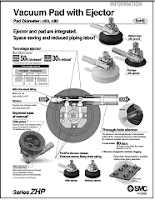
New from SMC - Vacuum Pad with built on Ejector Series ZHP

SMC's new ZHP series vacuum pad with ejector saves space and reduces piping labor. The two-stage ejector features a 50% increase in flow (over single stage ejectors) and a reduction in air consumption by 30%.
Other features:
- One-touch fitting connection (4mm, 6mm, 5/32", 1/4")
- Strainer
- Built in silencer
- Port for vacuum release, pressure sensor or daisy-chain piping
Contact Scott Equipment
Catalog Link
Wednesday, June 17, 2015
New Whitepaper: Introduction to accuracy and repeatability in linear motion systems
How accurate is an actuator?
The answer to this question is more than a number. Accuracy and repeatability are two important specifications of a linear motion platform. Though they are related, accuracy and repeatability in linear motion systems are not the same thing. The motor, drive and actuator itself all influence these specifications. Sometimes, repeatability is more important than overall accuracy. The relative importance of the two depends on a thorough understanding of your application.
To learn how accuracy and repeatability affect a rodless actuator platform, download the Tolomatic white paper.
Friday, May 29, 2015
New Hazardous Location Magnetic Proximity Sensor - 7HL
New from Canfield Connector - Hazardous Location Magnetic Proximity Sensor
This 7HL rugged magnetic proximity sensor is designed to sense actuator position in stringent, hazardous location applications. The switch features a robust, epoxy-filled, aircraft aluminum body, and has a vibration and shock resistant, electronic circuit. The 7HL is an expansion of the popular Series 7000 "floating" clamp design and will clamp on 2 to 8 inch bore NFPA tie rod linear actuators.
Canfield Magnetic Sensors are available in either reed or electronic sensing styles, the sensors are fully encapsulated for IP 67 service.
Additional Information:
Catalog Link: 7HL Catalog Page
Installation Guide: 7HL Installation Guide
Wednesday, May 20, 2015
SMC's New Modular Style FRL Combination - AC-B Series
Feature Overview:
- Mounting interchangeable with existing model
- Better visibility and safety from the Double Layer Polycarbonate bowl
- Easy maintenance and installation with the new spacer
- 7 to 125 PSI set pressure range
Better Environmental Resistance

The inner bowl is protected by a transparent polycarbonate bowl guard for complete protection without the need for viewing windows. Even when the unit is exposed to chemicals or oil, the inner pressure retaining bowl does not come in contact with the external contaminants.
Selection of Pressure Displays
Modular Connection
Tuesday, May 19, 2015
New F-Guides from LinMot
- Uses an industry standard high speed bearing and rail system.
- Increased actuator stiffness and smoother operation
- Stroke lengths from 5.5" to 74.7"
- Guides are shipped from stock 2-3 week delivery.
- Repeatability without an external sensor +/- 0.002 in
- Repeatability with an external sensor +/- 0.0004 in
- Uses LinMot's linear motors with an expected operating life on the motor of up to 2 billion cycles when properly applied**
- Synchronous Insertion or Cutting
- Product Sorting
- Product Rejection
- Product Assembly
- Product Repositioning including Rotation
- Container / Bottle Capping
- Conveyor Diverting / Positioning
- Label Positioning - Application
- Camera - Lighting Positioning
- Pad Printing
- Sealer Positioning and Control
If you have a specific application, would like to see a demo, need sizing assistance please contact Scott Equipment.
Wednesday, May 6, 2015
Easily Integrate Tolomatic's ACS Servo and Stepper Drive into Studio 5000 Logix Designer
| |
| ||||||||||||||||||||||||||||||||


